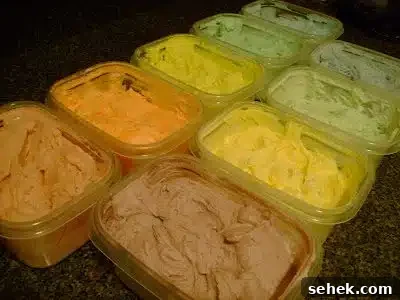
Tonight, as I prepare for a cupcake party my friend and I are hosting on Friday, I made several batches of buttercream frosting and tinted them in bright, festive colors. It’s been a while since I decorated celebration cakes that my former coworkers used to praise, so I’m getting back into the rhythm of cake decorating and hoping my skills are still intact.
Buttercream is a versatile icing used between cake layers, to coat cakes, and to pipe decorations. At its most basic, buttercream is made by creaming butter with powdered sugar. Other fats—such as margarine, vegetable shortening, or even avocado—can be substituted to change texture or flavor. Coloring and flavorings like cocoa powder or vanilla extract are commonly added to customize the taste and appearance.
The buttercream frosting I make doesn’t rely on precise measurements; instead I judge by texture and stiffness until it’s right for decorating. Below are the ingredients I used and the simple method I follow.
- unsalted butter
- shortening
- vanilla extract
- half & half
- powdered sugar
Method:
- In a stand mixer, cream equal parts unsalted butter and shortening until smooth and light. This blend balances flavor and stability—more butter gives better taste, while shortening helps hold shape at warmer temperatures.
- Add vanilla extract and mix briefly to incorporate the flavor evenly.
- Alternate adding a small splash of half & half with cups of powdered sugar, mixing until smooth between additions. Adjust the amount of half & half to control softness; add more powdered sugar to stiffen the frosting as needed.
- The ideal consistency for decorating is a “stiff” frosting. Test by holding a spatula or spoon in the bowl; if you can invert the bowl and the spatula remains suspended without the frosting slipping off, the consistency is right for piping and detailed decorating.
Tips:
- For smoother frosting, sift the powdered sugar before adding it.
- If the frosting becomes too soft, chill it briefly in the refrigerator and then re-whip to regain structure.
- To tint buttercream, use gel food coloring for more vibrant hues without thinning the frosting.
- Store homemade buttercream in an airtight container in the refrigerator for up to a week; bring it back to room temperature and re-whip before using.
With these basics, you can adapt the ratios and flavors to suit different cakes and decorations. I’m excited to practice more this week and see how the cupcakes turn out at the party.